

Investing in SAF Projects: Keynote summary | Skies Fifty
29-06-2026
During this years Annual Meeting, Kevin Fothergill, Partner at Skies Fifty delivered a Keynote on the key parameters while investing in SAF projects
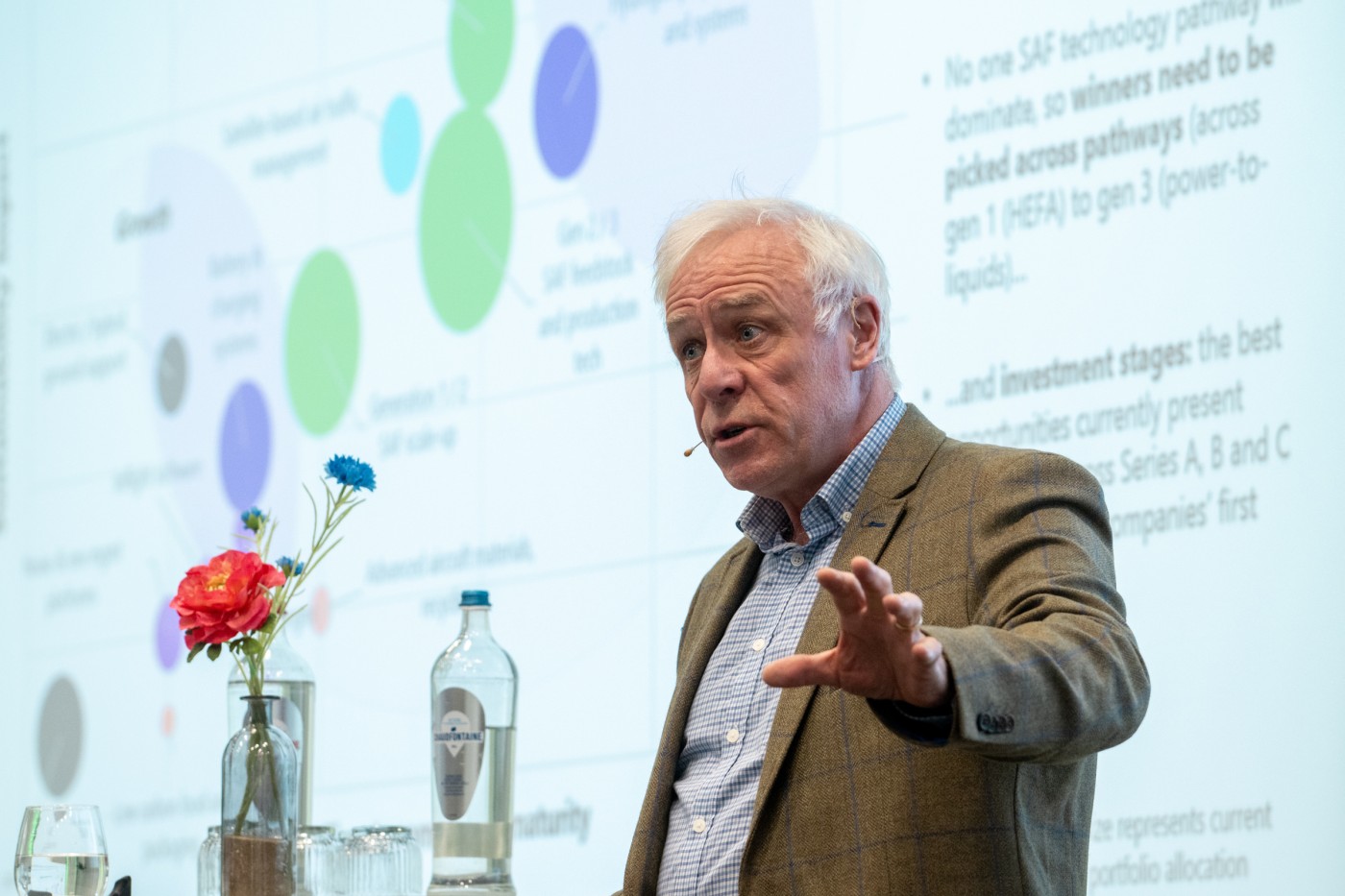 Kevin's presentation outlined an investment perspective on decarbonising aviation and maritime—two hard-to-abate sectors responsible for ~5–6% of global CO₂ emissions. Both sectors face structural challenges: high energy-density requirements, long asset lifetimes, and insufficient capital targeting early-stage to first-of-a-kind (FOAK) projects. Traditional efficiency gains alone are insufficient to reach net zero, creating a strong need for innovation-driven investment strategies.
To address this, SkiesFifty (and MarineFifty) position themselves as industry-focused investment platforms that combine sector expertise, financial structuring, and deep industry networks. Their dual objective is to achieve net-zero impact while delivering attractive financial returns. In aviation, the primary focus is on sustainable aviation fuel (SAF), seen as the most scalable near-term decarbonisation lever, complemented by emerging technologies such as hydrogen propulsion and advanced air systems. In maritime, investments span six areas, including alternative fuels (e.g. ammonia, methanol), vessel efficiency, port decarbonisation, and digital optimisation.
A central concept is the “Power-to-X trilemma”: projects must balance competitiveness (cost), resilience (risk robustness), and cleanliness (emissions performance). Optimising one dimension typically comes at the expense of others, making trade-off analysis essential for investors. The presentation highlighted that most emissions reductions (60–75%) depend on scaling new technologies such as Power-to-Liquid fuels, hydrogen, and CO₂ utilisation. However, projects face shared upstream challenges, including hydrogen cost and intermittency, CO₂ sourcing, and the “valley of death” between pilot and commercial scale. To manage complexity, SkiesFifty applies a structured 12-dimension investment framework, combining techno-economic analysis with independent validation (including collaboration with TNO). This enables consistent comparison across diverse opportunities and supports disciplined capital allocation. The key conclusion is that complexity in this space is structural. Successful investment requires rigorous, standardised assessment and strong ecosystem collaboration to de-risk technologies and accelerate scale-up.
Recently Skies Fifty signed a MoU with TNO to help them further in this structured 12-dimension assesment.
1) Independent technical validation
Provides objective assessments of fuel pathways and technologies. Verifies technology readiness, performance claims, and integration risks
→ Adds an external “reality check” to investment assumptions
2) Techno-economic analysis (TEA)
Delivers robust cost and performance benchmarking aligned with applied research. Evaluates CAPEX, LCOF, and scale-up risks
→ Supports more reliable financial modelling and comparability
3) System-level insight
Brings value chain understanding across SAF and Power-to-X systems. Assesses interdependencies (hydrogen, CO₂ sourcing, infrastructure)
→ Helps identify bottlenecks beyond the individual project
4) Scientific rigor & independence
Acts as a neutral, research-driven partner. Strengthens investor confidence through credible, evidence-based input
5) Impact on investment decisions
Improves investment judgement and risk assessment. Enables better screening between viable and high-risk projects
Supports building a stronger ecosystem around SAF scale-up
Bottom line
TNO elevates the framework from a traditional investment model to a science-backed investment approach, reducing uncertainty in early-stage technologies and increasing confidence in scaling Power-to-X and SAF projects.
Share this page:
