

New TNO Report on Experiences and lessons learnt from Renewable Hydrogen Projects
29-06-2026
This is a summary based on the original report (in Dutch)
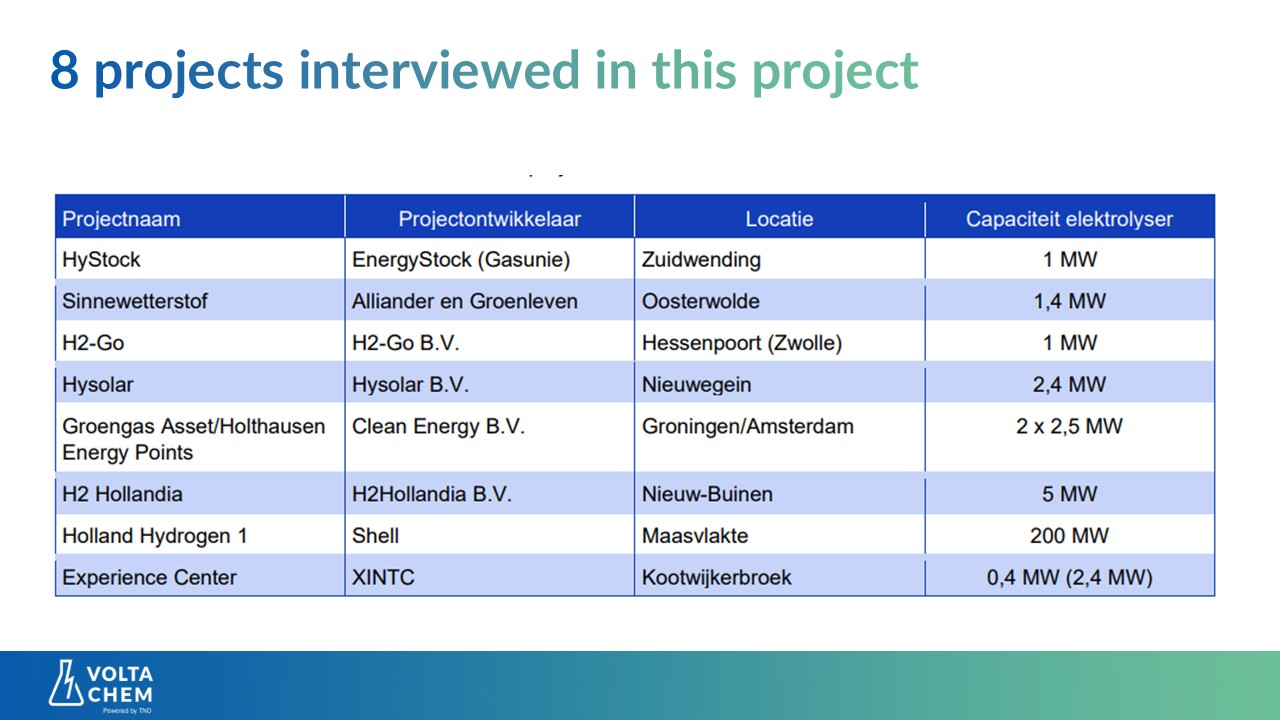 The RVO report “Experiences and lessons from renewable hydrogen projects” (based on interviews with eight Dutch electrolysis projects) interviewed 8 Dutch electrolyser projects to come to the realities of building electrolysis projects.
This project is based on interviews with developers of hydrogen projects, who took the time to carefully review the questionnaire, provide detailed answers during in-depth interviews, and subsequently review the interview reports.
Key challenges as identified in the report are summarised below.
- Immature technology – Limited long-term operating data makes technology and supplier selection difficult
- Lack of experience – Developers and supply chain partners have limited hands-on expertise with electrolysis systems
- Complex system integration – Aligning electrolyser, storage, and infrastructure adds technical risk
- High costs & weak business cases – Significant CAPEX, uncertain revenues, and evolving regulations
- Permitting & regulatory delays – Lengthy approval processes slow project progress
- Grid constraints – Difficulty securing timely and sufficient electricity connections
- Coordination challenges – Many stakeholders involved, increasing complexity and risk of delays
- Financing FOAK projects – Higher perceived risks make early-stage projects harder to fund
These challenges collectively lead to delays, cost overruns, and slower scale-up of renewable hydrogen projects.
The RVO report highlights a set of practical actions to improve the success and scalability of renewable hydrogen projects. First, it emphasises the importance of simplicity in project design. Projects should avoid unnecessary technical complexity and limit the number of partners involved, as complexity increases integration risks, delays, and costs. Starting with modular, proven configurations can significantly improve execution. Second, early stakeholder engagement is critical. Developers should involve grid operators, permitting authorities, financiers, and policymakers from the outset to prevent bottlenecks in grid access, permitting, and financing later in the project.
Third, the report stresses active knowledge sharing across the sector. By exchanging lessons learned, developers can avoid repeating common mistakes and accelerate the overall learning curve of the industry. Fourth, there is a clear need to strengthen expertise and capabilities, particularly in system integration, safety, and engineering. Many current challenges stem from limited practical experience with electrolysis systems. Fifth, projects should adopt a system-level perspective, ensuring proper alignment between electricity supply, hydrogen production, storage, and infrastructure. Poor coordination leads to inefficiencies and suboptimal designs.
Overall, the report concludes that success depends less on breakthrough innovation and more on better coordination, simplification, and collective learning across the ecosystem.
VoltaChem, a TNO run and led neutral business platform is perfectly positioned to play a role in untangling these coordination and system level challenges at a project level in this sector.
Share this page:
